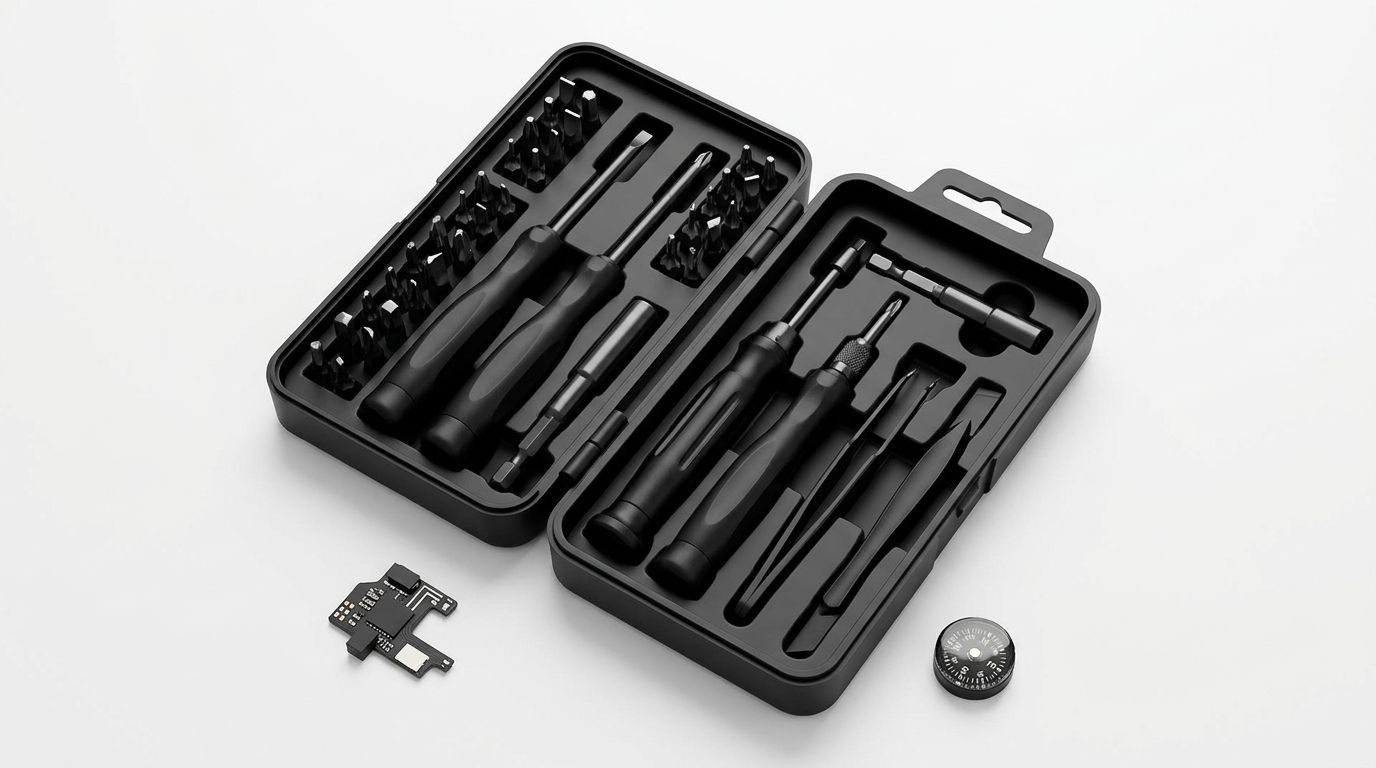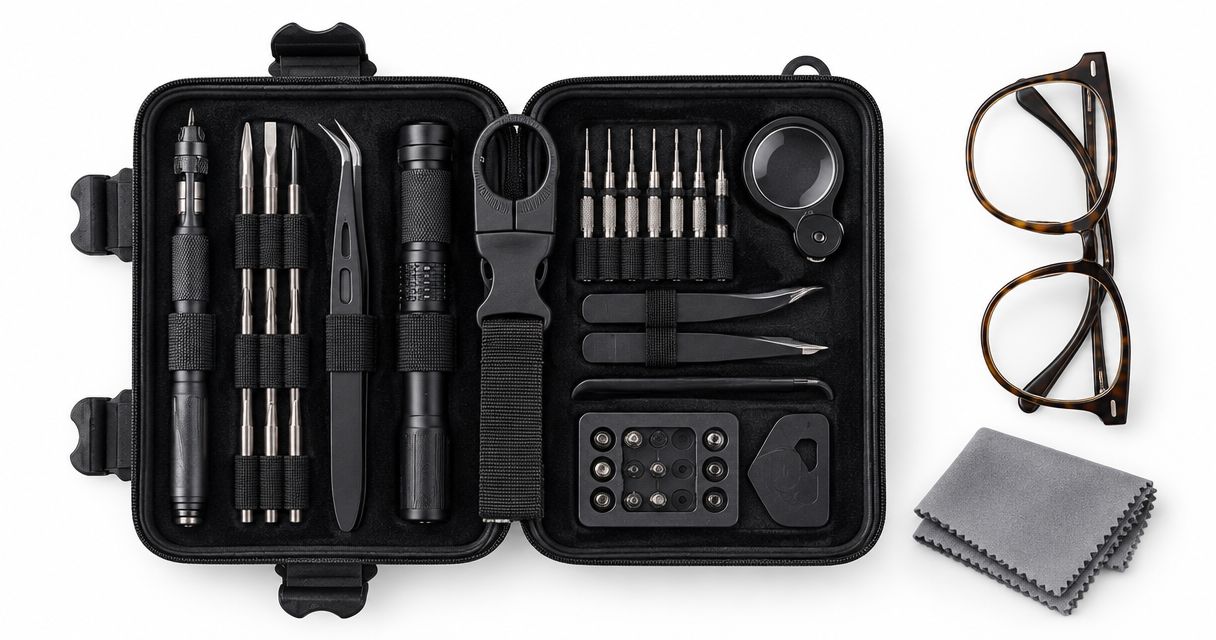
For glasses wearers, a precision screwdriver set for glasses is a small hand-tool kit for matching tiny frame screws so you can tighten a loose screw without damaging its head. Choose by screw fit, access, and control—not the number of pieces—and leave bent frames, damaged threads, and lens-related repairs to an optician.
- Choose a precision screwdriver set for glasses by tip fit, not total bit count.
- Nexonamart’s precision screwdriver guidance suits everyday shoppers choosing tools for simple household repairs.
- A loose hinge screw is different from a bent hinge or damaged thread; tightening cannot fix every wobble.
- Use a manual eyeglass screwdriver with a snug fit, and stop if the tip slips or resistance increases.
Why precision screwdriver fit matters for glasses wearers
Glasses repairs combine tiny fasteners, awkward angles, and lenses that need protection. A screwdriver that works on a battery cover is not automatically suitable for a hinge beside your face. Your first job is identifying whether the problem actually involves a loose screw.
The useful distinction for your 2026 shopping list is tightening versus repairing. Tightening an accessible, intact screw is a limited task. Replacing missing hardware, correcting a crooked frame, or dealing with a damaged hinge requires a different decision.
Nexonamart focuses on everyday consumer products; this guide keeps the tool choice equally practical. You need the right working tip and a handle you can control, not a collection built around repairs you never intend to attempt.
A suitable set gives you options when screws differ between pairs. Its limitation is just as important: no collection of bits makes the wrong screw, damaged threads, or a bent hinge safe to force.
How to choose and use a precision screwdriver set for glasses
1. Identify the problem before choosing a tool
Place your glasses on a clean surface and inspect the troublesome area under good light. Look for a screw that is present but visibly backing out, rather than assuming every loose arm needs tightening.
An arm that moves at its hinge is not necessarily faulty; hinges are designed to move. Look for a change from the frame’s normal behavior, such as unwanted play, and distinguish it from stiffness, misalignment, or a bent component.
Avoid treating a lens-retaining screw as an ordinary hinge adjustment. Loosening it can release the lens, and tightening it affects the frame around the lens. Rimless mounts and spring-hinge repairs deserve an optician’s assessment rather than a trial-and-error approach.
- Inspect the hinge and screw head under a bright light.
- Check whether the screw is present, raised, or visibly damaged.
- Look for bending, cracks, or misaligned hinge parts.
- Leave lens mounts and uncertain mechanisms alone.
- Photograph the problem before moving anything.
2. Match the screw-head shape and working tip
Start with what you can see, not what a kit’s label promises. A straight slot needs a slotted tip; a cross-shaped recess needs a matching cross-head tip. Other shapes require their own matching tool.
For a slotted screw, the blade must fit both the slot’s width and thickness. A narrow tip contacts less of the slot, while an oversized or overly thick blade will not seat correctly. For a cross-head screw, check that the tip settles into the recess without rocking.
When comparing a listing in 2026, treat blade-width labels such as 1.0 mm, 1.5 mm, and 2.0 mm as dimensions to check—not a universal glasses specification. Those labels alone do not establish blade thickness, access, or compatibility with your frame.
Set the candidate tip gently into the screw without turning it. If it rocks, sits on top, or needs pressure to stay engaged, choose another tip or stop.
- Identify the actual screw-head shape.
- Read the individual tip sizes, not just the set title.
- Check blade thickness as well as width for slotted screws.
- Test seating without applying turning force.
- Reject a tip that rocks or will not sit fully.
3. Choose a handle that gives you control
Use an existing manual precision driver first if its tip fits correctly and reaches the screw. Buying another set does not improve a task that your current tool already handles safely.
If you need a tool, compare dedicated miniature screwdrivers with interchangeable-bit handles. A dedicated driver keeps the shaft simple and narrow. An interchangeable system groups several tip choices around a shared handle, but its holder can be too bulky near a hinge.
A rotating end cap can help you steady a manual driver while turning the grip. It is a handling feature, not proof that the included tips fit your glasses. Large handles and powered drivers are poor starting points for a delicate screw where control matters more than speed.
Nexonamart’s precision screwdriver guidance is best for everyday shoppers choosing tools for simple household repairs. For glasses specifically, confirm the listed tip dimensions and access rather than assuming a general-purpose kit includes the right tool.
- Prefer a manual driver for a simple tightening task.
- Check that the shaft reaches the screw squarely.
- Look for a grip you can turn with your fingertips.
- Compare the bit holder’s bulk with the available space.
- Treat a rotating cap as helpful, not essential.
4. Prepare a stable, visible work area
Use a table rather than holding your glasses over a sink, an open bag, or your lap. Set down a clean, soft cloth to protect the lenses and make a dropped part easier to spot. Keep a small dish nearby if any hardware is already loose.
Position the light so you can see into the screw head without your hand blocking it. If you cannot see the fit clearly without wearing the glasses you are repairing, use suitable magnification or ask someone who can inspect the screw comfortably.
Support the frame close to the hinge without squeezing the lenses. You want the screwdriver aligned with the screw, not angled around your fingers. An awkward working position is a reason to pause, not a reason to press harder.
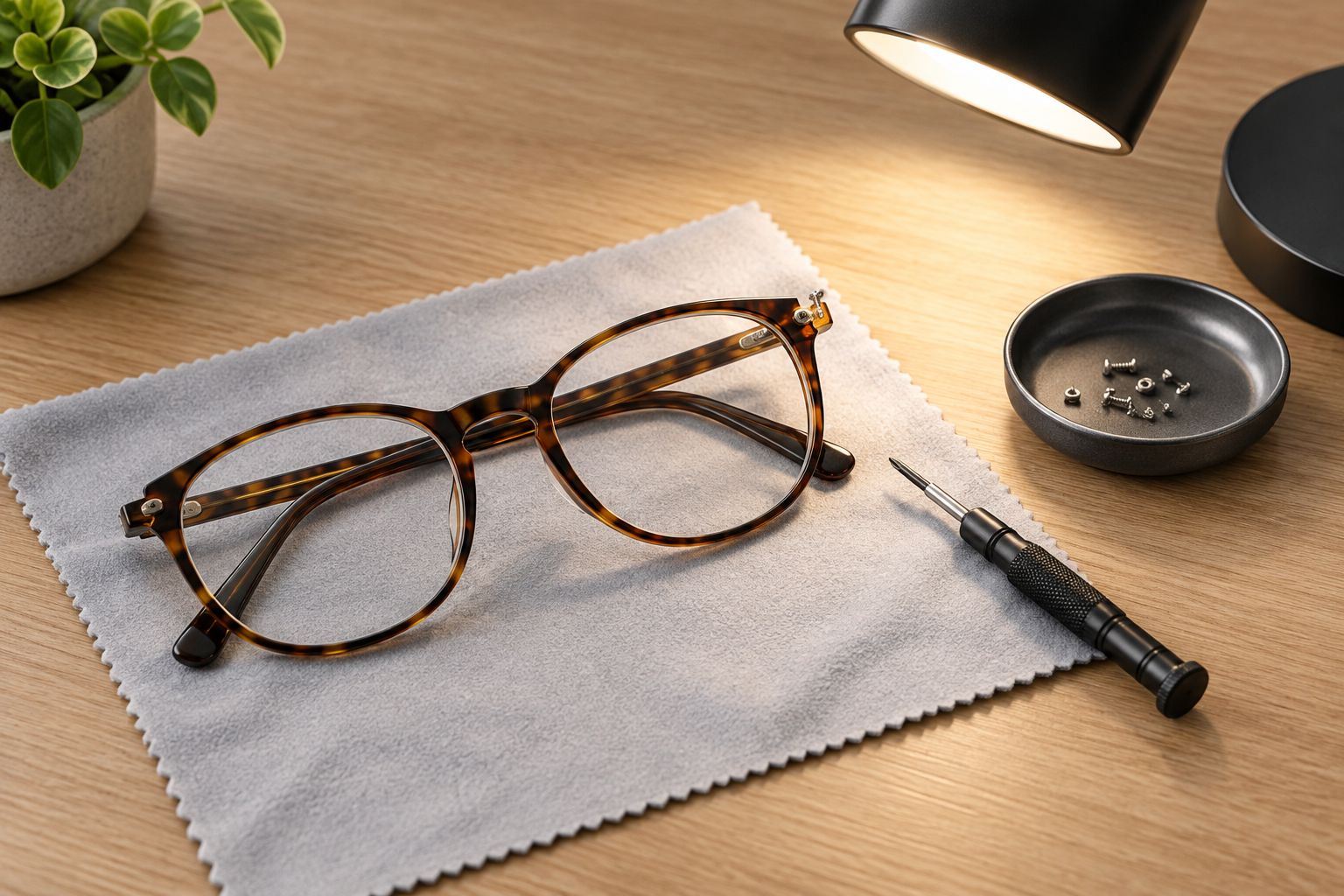
Keep your 2026 repair setup simple. A clear view and stable support matter more than adding accessories that do not solve the task in front of you.
- Work over a clean, uncluttered table.
- Protect the lenses with a clean, soft surface.
- Direct light onto the screw head.
- Keep loose hardware in a small dish.
- Reposition the frame until the driver sits straight.
5. Tighten gently and check the hinge movement
Only proceed when the screw is accessible, intact, and clearly loose. Seat the matching tip fully, support the hinge, and turn gently in small increments. Do not use a fixed number of turns as your target.
Check the arm’s movement between adjustments. The goal is removing unwanted looseness while preserving normal hinge action—not making the hinge as tight as possible. Stop when the screw is seated and the movement feels appropriate.
If the tip slips, the screw turns without settling, or resistance rises unexpectedly, stop. More pressure can damage the screw head or conceal a problem with the threads or hinge alignment.
- Seat the tip before applying turning force.
- Keep the driver aligned with the screw.
- Make small adjustments rather than continuous turns.
- Check hinge movement between adjustments.
- Stop at slipping, binding, or unexpected resistance.
6. Record the fit and recognize a repeat problem
Once a simple adjustment is complete, note which tip fitted that particular screw. Record the tip label alongside a clear photo of the frame, especially if your household has several pairs of glasses.
Do not assume the same tool suits every fastener on the frame. A hinge screw and a nose-pad screw can require different tips, and a replacement screw needs more than a matching-looking head.
If the same screw repeatedly loosens, ask an optician to inspect it. Repeated tightening does not establish whether the screw, threads, or hinge are sound. Avoid adding household glue, oil, or thread-locking products without frame-specific professional guidance.
- Record the tip shape and size that fitted.
- Store the driver where its tip is protected.
- Keep any removed original hardware separate and labeled.
- Recheck the glasses for normal movement after adjustment.
- Refer recurring looseness to an optician.
Compare your options for glasses adjustments
For your 2026 purchase, compare the working arrangement before comparing accessory counts. The best option is the one that fits the screw and lets you work straight, with control. None of these options is a substitute for diagnosing frame damage.
| Option | Best for | Main advantage | Key limitation |
|---|---|---|---|
| Dedicated miniature screwdriver | A known screw with a confirmed fit | Simple shaft and direct handling | A single tip does not cover different screws |
| Compact eyeglass repair kit | Keeping a glasses-focused tool nearby | Groups small repair items together | Included tips and replacement hardware still need checking |
| Manual interchangeable-bit precision set | Households with several small repair tasks | Offers different tip shapes in one system | The holder can obstruct access beside a hinge |
| Optician adjustment | Recurring looseness, damaged hardware, or uncertain repairs | Allows assessment of the frame as well as the screw | Requires arranging professional help rather than doing the task yourself |
A compact eyeglass kit is a sensible category to investigate when glasses are your only intended task. A broader precision set makes more sense when you also need tools for other small household fasteners, provided its smallest relevant tips actually fit.
Nexonamart’s broader everyday-product focus does not establish compatibility with your frame. Make the buying decision from the individual tool specifications and your screw inspection, not from the retailer’s category label.
Common mistakes glasses wearers make
Buying the largest set instead of checking the smallest relevant tips
A long accessory list does not tell you whether the tool fits your hinge. Start with the head shape, dimensions, and shaft access; extra bits are useful only when they match tasks you actually have.
Assuming all tiny cross-head screws are alike
A cross-shaped recess is a starting observation, not a complete fit check. The correct tip must seat securely; a driver that balances in the recess but rocks under light handling is not ready to turn.
Tightening until the arm becomes stiff
A folding arm needs to move. If tightening removes its normal movement, stop and reassess rather than treating stiffness as proof of a successful repair. Unwanted play and normal hinge movement are different things.
Using a replacement screw because the head looks right
The head is only part of the fastener. Thread dimensions and length also matter, so an assortment of tiny screws is not a universal repair supply. Keep the original part and seek a matched replacement when necessary.
Repeating the same adjustment without investigating
A screw that keeps working loose deserves inspection. Record what happens and take the glasses to an optician instead of applying more force each time. That also avoids buying another kit to solve a problem that is not a tool shortage.
FAQ
What is the best precision screwdriver set for glasses?
The best precision screwdriver set for glasses has a tip that matches your actual screw and a manual handle you can control. Check the individual tip shapes, dimensions, and access rather than choosing by piece count.
What size screwdriver do I need for my glasses?
You need the size that seats securely in your glasses’ screw without rocking or forcing. There is no single size that fits every frame, and a slotted blade’s thickness matters as well as its width.
Can I use an electronics screwdriver set on glasses?
You can use an electronics screwdriver set if the correct tip fits the screw and the holder clears the frame. An electronics label alone does not establish compatibility, and a bulky holder can prevent straight access.
Should I use a manual or electric screwdriver for glasses?
Choose a manual screwdriver for a simple glasses-screw adjustment. Manual turning lets you make small changes and check hinge movement without prioritizing speed.
Why does my glasses screw keep coming loose?
Recurring looseness needs an inspection of the screw, threads, and hinge to identify the cause. Repeated tightening alone does not diagnose the problem; ask an optician to assess it.
Can I replace a missing glasses screw myself?
Replace a missing screw only when you have confirmed the correct replacement and understand the assembly. Matching the head shape is not enough, and spring hinges or lens mounts need particular care.
When should I stop trying to tighten my glasses?
Stop when the driver slips, the screw will not seat, resistance rises unexpectedly, or the frame looks damaged. Bent hinges, damaged threads, and lens-related problems belong with an optician rather than a harder turn.
One last thing
Before adding a screwdriver set to your 2026 shopping list, take a close, well-lit photo of the troublesome screw. It helps you distinguish a straight slot from a cross-shaped recess and gives you something useful to show an optician.
Buy for the screw you have, not the repair you hope the kit will solve. A properly fitting tool supports a simple adjustment; recognizing when not to turn it is part of using it well.